Showing posts with label influences. Show all posts

Monday, February 25, 2013

The Importance of Story


Heroes, heroism, and what all that entails, is a fairly common theme on this blog. It wasn't until I read through Diana Wynne Jones' essay collection, followed by The Wand in the Word, that I started to understand some of my impulses that drive me to contemplate such ideas, and to search for ways to bring them into my stories without even realizing it.

We as a society, especially here in America, are in desperate need of heroes. Not even real-life heroes, though those are (obviously) important, but heroes of mythical stature, for us to look up to and emulate without even knowing it. America is a funny land: we have absorbed so many cultures to make up this beautiful, multi-facted nation, and yet we haven't embraced any of their myths - nor do most of us embrace the mythos of the Native Americans, which is beautiful and rich and deep.

Instead of myths and legends reaching back into a shadowy past, showing us heroes and heroines and quests and striving for a goal more noble, we have generations of Americans raised on Disney princesses and Power Rangers as children, vampires and dystopias as teenagers, gossip magazines and reality television as young adults. Not all of those things are bad - but they aren't anything close to enough.

We have no King Arthur, no rich carpet of legend rolling out beneath our feet, for us to tread upon and absorb without even knowing it. The closest thing we have in this country to a cultural mythos are comic book heroes, and while those have their own value, they don't have the weight of age behind them.

That's not something I can change. I don't have a TARDIS, I can't pop back in time to create another Beowulf.

But I, personally, have a strong sense of the importance of heroes. As a kid, I fought imaginary dragons in my back yard. I believed in standing up for the underdog, even in my kindergarten class, wearing a pretty dress with my hair in two long braids, not letting anyone bully Thomas because he didn't fit in. How did that happen (aside from my parents' teaching)?

The books I read, the Stories I learned. What books did I grow up reading? Books by Lloyd Alexander, Susan Cooper, CS Lewis, JRR Tolkien, Brian Jacques, Edward Eager, E Nesbit, L Frank Baum ...

People say fantasy doesn't matter? That fantasy books aren't Real Books?

It is fantasy, myth, legend, the hero seeking to save others, the beauty of the quest through danger to achieve salvation, that will rescue this world from falling into utter darkness.

In the end, fantasy books are the most Real Books out there. They just might be the most important books you will ever read.

They are certainly the most important books I will ever write.

Wednesday, January 30, 2013

Happy Birthday, Bard of Prydain (and beyond)

Today is Lloyd Alexander's 89th birthday. Of course I had to write a tribute.

There aren't enough words, especially in a blog post, to give the proper idea of the influence this man has had on me. My writing, for one, but in my life as well. His characters, his stories, and more important, the ideas behind his stories, the hidden and subtle threads that wove their way through every tale he told, have all conspired together to shape my world view and my personality.

His own character as well has been an inspiration to me. Everything I read about him indicates he was a kind man, with great humility and a marvelous sense of humor, someone who never lost his sense of wonder at the magic that exists in the world all around us, for those with eyes to see it.

He is one of those giants upon whose shoulders I attempt to stand. I am ever thankful for him.

I wrote, a few years back, a little story set in a post The High King Prydain. I skipped the entire dilemma of "how did Taran and Eilonwy put the kingdom back together?" by focusing on their children, in a settled kingdom that had accepted the departure of the Sons of Don long ago (cheating! I know!). It's not the most perfect story I've ever written, but I am fond of it for the message it conveys. It is, in a small way, part of my tribute to the lessons I've learned from Lloyd. If such thing interest you, feel free to read it!

Thank you, Lloyd, for the gifts you scattered on the earth during your lifetime. May your legacy grow ever greater as the years pass.


Wednesday, October 24, 2012

Grandma

Breaking my post-once-a-week pattern for a particular reason ...

One year ago today, my grandmother ended her battle with Alzheimer's after twelve years. She had spent almost the entire previous week in the hospital with pneumonia, and all her family was told form the beginning that this was it; she wasn't going to be leaving. After many days spent by her bedside, in laughter and tears, she died surrounded by her children and grandchildren, gone but never forgotten, though her own memory went so many years ago.

I've been thinking this week about Grandma's legacy, about how her love, her faith, her hope, and her humor have passed down now to three generations, with who knows how many more to come. Whenever I am tempted to think that my sphere of influence is too small to make a difference, that my presence in this world doesn't really matter, I remember this wonderful women who lived in a tiny corner of the world, raising her children and planting her gardens, and whose life touched so many and continues to do so even now. No person is too small or too insignificant to make a difference. We never know how far the ripples of our life may travel.

I'm including here in this post the tribute I wrote to Grandma last year, the day after her death. And at some point today, I will sit down with my girls, show them some pictures on their uncle's Facebook wall of their grandmother, and tell them some of the stories I remember best.

She is gone, but her love and her humor live on.

She went out accompanied by a blaze of northern lights, some of the most brilliant seen around here in ages. Heaven welcoming a gallant soul home with fanfare.

Even after her breathing had slowed drastically, her heart remained strong until the end. We always knew her heart was bigger and stronger than most.

Her humor was one of the last things to go when the Alzheimer's took over. Even when she was in the nursing home and couldn't even recognize Grandpa, she would try to tease the nurses and aids. They all loved her.

They were married for sixty years. Two days before she finally died, I sat and watched him hold her hand as he told us the only reason he underwent chemo and fought so hard for life through the blood clots last year was so that he could take care of her, make sure her ending was peaceful and dignified, so that he could take care of her to the end. None of his kids could speak at that point, so I managed to choke out that he had done a wonderful job of it. They were an example to us all.

Of eight kids, six managed to make it home to say goodbye, only the one in Australia and the one in Arizona not able to get back. Fully half of the grandkids were able to come. No one fought, no one argued, no one tried to make things difficult for anyone else. Everyone acted as selflessly as human beings can act. Another testimony to the love and respect everyone had for her.

The hospital nurses teared up when their weekend shift ended, knowing they wouldn't see her again alive.

There was as much laughter as tears around her bedside, as stories were shared and memories were dredged up and old jokes revived. Her fifteen-year-old grandson played his guitar, everyone sang, and her last days were filled with the music and laughter she loved so well.

She has been gone for a long time. Twelve years ago was when she was finally diagnosed with Alzheimer's, at that point too far advanced to do anything but watch and pray as it slowly disintegrated the woman we all knew. The pneumonia that took her tonight was a release from that living death (twelve years is phenomenally long for Alzheimer's sufferers - most don't live more than five years), and our tears were as much joy for her as sorrow.

She is whole again now. She is free. She is rejoicing and laughing with her Lord.

It hurts, still, but this is a clean hurt, one that will heal. The pain of the Alzheimer's never went away; it would lie dormant for a time, but it was always there lurking in the background. This - already there is a peace growing from the sorrow.

We will miss her. We have missed her for years. But her legacy - the love, the laughter, the strength and faith and joy - she passed that on, not only to her children, grandchildren, and great-grandchildren, but to all who knew her. I am proud to call myself her granddaughter, and you can be sure my girls will grow up knowing about what an amazing woman their great-grandmother was.

Rest in Peace? Maybe. Personally, I suspect she is singing and dancing right now.

And laughing.
Grandma as a girl                                                                        Senior portrait

Grandma and Grandpa's wedding day


Monday, September 24, 2012

I am French

Disclaimer: This post has nothing to do with writing. It just seemed like an interesting topic.

When people ask me what my family heritage is, I don't even hesitate.

"French," I reply promptly.

In truth, French is a tiny part of my heritage. I am 1/8 French, to be precise. My father's father's mother was a Frenchwoman. The rest of the blood on my dad's side is a mix of English, Dutch, and Irish, with a drop or two of Welsh.

On my mom's side, we're English and Scottish (and pure New Englander). Nothing else.

So really, I'm more English than anything else. English and Celtic, maybe.

But still: "French," I say without even thinking about it.

And I sometimes wonder why that is? Is it because Great-Grandma Bates was such a strong personality? I was very young when she died, but even I have a few distinct memories of her, and I've heard stories about her all my life from my dad and his siblings (and their cousins). I'm much more of an Anglophile than a Francophile, yet I rarely talk or even think about my English blood.

Is it because the personality traits I value the most in myself are ones commonly associated with French people? Passion, joie de vivre, honor, clear-headedness in a crisis. Or that some of the traits I most desire for myself (and are forever out of reach) are also associated with the French? Sophistication, elegance, poise, reserve, tact.

You can see, in my grandfather's generation, the humor of my English great-grandfather and the charm of my great-grandmother mixed together almost irresistibly (my dad and I took Grandpa and one of his brothers out for lunch one day, a few years ago, and both Grandpa and Uncle Fred got free pie, just because the waitresses were so delighted by them). In my dad's generation, the charm has been diluted just a tad (but not much, as anyone who knows my dad and his siblings would agree) and the humor kicked up a notch due to my grandmother's genes (even after the Alzheimer's took everything else away from Grandma, she maintained her sense of humor until there was simply nothing left of her at all).

Me, I'm an odd blend of Scottish practicality, English humor, Celtic passion, Dutch shrewdness, and French joy (and a generous handful of less pleasant traits, too - but I'll leave those for you to figure out) (no giving anyone clues, Carl). And maybe that's what it boils down to - of everything I am and want to be, joyful is the most important to me. When I die, I want "extravagantly joyful" written on my tombstone (actually, that's a lie - I don't want a tombstone at all - but you get the idea). To live fully and joyously, to face bravely whatever lies ahead and navigate whatever treacherous waters there may be with a triumphant laugh, to spend my days with a song on my lips and a smile in my heart, and I'm going to stop there before this devolves further into cheesy pop song territory.

Despite my complete and utter lack of glamor, at my core, I feel French. That 1/8 burns stronger in my veins then all the rest of it. And if the French aren't really like that after all?

Experimenting with some french couture a few years ago. Always fun!

Oh well. I'm a writer. Creating worlds and imaginary lands and then dwelling therein is what we do.

What is your family heritage, and do you feel yourself drawn more strongly to one part over another?

Thursday, August 16, 2012

Palace by the Sea

I read Eva Ibbotson's The Secret of Platform 13 last week, and thoroughly enjoyed it. How have I never read anything of hers before? And why do I keep saying that about all these fantastic writers? I suppose it might be considered a good thing, though - if I had found all of them when I was a kid, I wouldn't be getting these fantastic discoveries now.

At one point in the story, she mentions that the king and queen of the Island don't live in a fancy palace with uncomfortable thrones, but in a "low white house on a curving beach on golden sand studded with cowrie shells". I loved that idea. I loved it so much that it sparked a little snippet of a story on its own. This snippet will probably never grow to be a full-grown story, but that's okay. I had fun writing it, and who knows? Maybe someday it will find its way into a bigger tale.

The queen waited expectantly. 
It was a lovely scene, to be sure. The deep azure sea rippling in the playful wind, the pale golden sands turning gradually to grey and white pebbles and finally to long grasses, the long, low, sprawling house nestled back amongst the willow trees as the land slowly turned to field and then forest. Beautiful, but something wasn’t right. 
Colin turned slowly in place, eyes wide as he searched for the missing piece.
“Something troubles you, friend?” the queen asked. The sea breeze tossed her long brown hair over her shoulders and across her face. She brushed it aside with a smile. 
“Where’s the palace?” Colin blurted. She looked blank. “The castle? Where you live?” 
The queen’s laugh rippled through the air. “Why, here!” She motioned at the rambling white house. “What are these other buildings of which you speak?” 
“Well, um,” Colin stumbled. “I, uh … oh, wait! Is this your retreat? Where you come to escape the affairs of state? Your true home is in the city?” 
Her smile turned puzzled, though she was as polite as ever. “City? I do not know these words, friend. Here is where I live, I and all others who need a home. Some stay on permanently, some move on to create their own homes after a time, but all are welcome. Our ‘affairs of state,’ as you call them, do not happen in only one place. How could they, when the kingdom spreads so wide? I and my helpers travel where we are needed, tending what needs to be tended, and when the time comes to rest, we return here until we are called forth again. Is this not how it works in your world?” 
Colin snorted. “Not exactly.” It seemed an awfully naive way to conduct a kingdom—but he had to admit that all of Queen Molly’s subjects, and the queen herself, seemed perfectly happy. 
Maybe there was something in it after all. 
“Most sensible,” Aunt Agatha said. Colin jumped. He hadn’t noticed his aunt and the rest of the entourage joining them. 
Aunt Agatha set her basket down in the sand with a thump. “Who wants a palace anyway? Just more rooms to clean. And thrones? Horrid, lumpy, unapproachable things. No, your way is much better, my dear.” She bestowed a rare smile on Queen Molly, who bowed graciously in return. 
Colin felt his ears turning red. Trust Aunt Agatha to patronize a queen! Granted, Molly was very young to be a queen (and very plain, his inner voice whispered), but still. Aunt Agatha, he suspected, would patronize the Emperor in Rome were that gentlemen ever unlucky enough to have her travel back through time and meet him. It was How She Was.

Thursday, July 26, 2012

Going Back

With finishing my short stories (all spy- or detective-related), I decided to take a break from all the mysteries I've been reading lately and go back to my roots. This was partially inspired by the fact that I'm getting to loathe all fictional private detectives (except Sherlock Holmes, DUH), and partially because, to my surprise, some of my critique partners rattled off a few different writers whose style they could see had influenced me -

And not one of them was Lloyd Alexander.

Which quite frankly flabbergasted me, because for many years my writing style read like a composite of Lloyd Alexander and Brian Jacques, and Jacques only because he was so prolific that he infused my writing without me ever realizing it.

If there is one author I would aspire to write like, it's Lloyd. So I'm picking up some of his books again and reminding myself of just what it is in his writing that I love so well, and make sure that I haven't lost that in my own writing - not that I want to write in his voice entirely, of course, but that the same spirit breathes in my writing that lives in his.

I'm reading Westmark right now, which is the start of one of his less-popular series, but one that I love dearly. Then I'll probably go on to the Vesper Holly books, for their sheer outrageous fun (oh how I love Brinnie; as a kid I wanted to identify most with Vesper, as an adult I have utter sympathy for Brinnie), and then we'll see from there.

He breaks so many of the "rules" of writing, and yet his genius is such that it works. That doesn't mean I'm going to go about breaking rules willy-nilly, but it does help me remember to hold them loosely, and if I have to choose between the story and the rules, GO WITH THE STORY.

It feels like visiting old friends, going back to Westmark and thinking about Vesper &co. I'm actually glad for an excuse to go back there, preferably with a cup of tea by my side.

Mmm ... anyone else remember when the weather was cool enough to want wrist warmers? Yeah, me neither.


(Mind, I'm not complaining about any of the writers that were mentioned as being obvious influences on my writing; they are all brilliant writers and have influences me in one way or another, but since Lloyd is the BIGGEST influence on me, I was just surprised that he didn't make the list.)

Thursday, July 19, 2012

The Why Behind the Word


Life has been weighing heavily on my shoulders this week. You know how it is sometimes? It seems like everywhere you turn there's more tragedy, more brokenness, more need, more heartache, and it's all so much you don't even know where to begin.

And it's not just the sad stuff. You read stories of people triumphing against the odds to rescue a street boy from an impossible life in Africa. Firefighters doing ridiculous things to save people's homes in Colorado. People advocating for those who have no voice. All over, people doing their part to bring healing to this broken world.

And this is what always gets me - the need is so big, and so widespread, and others seem to know what to do to meet at least some of the need, but I get so overwhelmed and feel so feeble. What can I offer? Where do I begin? How do I take care of what's already been entrusted to me and still have something left to give to the world?

Tuesday night, I heard that my hometown was shredded by a micro burst. Literally. Several downtown building were horrifically damaged, including the local hardware store where I worked from when I was a young teenager right up to a week before I got married. The store my dad has worked at for over 30 years. The roof was lifted completely off and flung into the river, and the sub roof couldn't hold out the rain, and the water just flooded in. At one point they weren't even sure they could salvage the building.

I was sick. Just sick, thinking about it. And Wednesday morning, when I heard about the community coming in and pulling together to help bring the store back from the brink, to the point where it could re-open for business this afternoon and start giving back to the rest of the community, it killed me that I couldn't rush right home and join in.

But Grace woke up puking that morning, and I had to take care of her. No home-rushing heroics for me. At one point during the morning I looked at the short spy story document open on my computer and put my head right down on the table and said "WHY? Why do I write? What good does this possibly do in the long run? Why am I spending my time on this earth writing instead of doing ... something?"

(And then I had to go hold the puke bucket for Grace again. Truth.)

The more I thought (and prayed) about it, though, the more certain things started to come clear. Would I even be the type of person who wants to do something if it weren't for the books I grew up reading? Would I be the Louise I am today if I hadn't grown up with Lucy and Edmund, Anne and Diana, Randy and Rush, Taran and Eilonwy, Will and Bran, and all the rest? In my "Influences" posts, the common thread is that not only did these books shape me as a writer, they shaped me as a person.

It's an odd circle - if it weren't for people doing great things, writers wouldn't be able to imagine such deeds to write about. If it weren't for writers creating great heroes and deeply compassionate characters, real people might never be inspired to do great things themselves. We need books to show us the people we want to be.

That's why I write. I write to bring hope, to inspire courage, to give comfort and encouragement. Even in real life, my role has always, since childhood, been that of an encourager. Writing is my way of spreading that beyond my circle of immediate family and friends. It doesn't excuse me from acting in real life, too (and I pray that I will always be ready, in season and out, to act where I am needed and able), but it helps to give me a purpose, to remind me that my writing is not just for escapism or amusement. Not that there's anything wrong with that, either (and certainly my spy stories are mostly sheer indulgent fun), but that can't be all. Not for me.

This all sounds kind of pompous, looking it over now. "See me, how noble my goals are for my writing!" I don't mean it that way. Rather, it makes me humble, seeing how very far I have to go before I can live up to my own hopes. And it helps to keep me grounded - when I have a day that I can't write because my poor baby is retching on the couch, I can let that go more easily, because this is the real life that the writing is supposed to help inspire me toward.

My very favorite sort of stories are those of ordinary people doing extraordinary things. And I hope that's the life I can live, and the stories I can write to encourage others along the same path.

Monday, June 25, 2012

Influences: Agatha Christie

As a kid, I had pretty bad problems with nightmares. The tabloid pictures of the infamous "Bat-Boy" scared me so badly I couldn't walk through the checkout line at the grocery store for years. Years.

So it may come as a surprise that I adore mysteries. However, I don't read the really gruesome stuff. I mostly love the mystery writers from the Golden Age - Dorothy L Sayers (LORD PETER FTW!!!!!); Anthony Berkeley; Margery Allingham (Campion may start out as a pale imitation of Lord Peter, but quickly develops into his own charming self); Josephine Tey; Ngaio Marsh; and I've been trying to read Freeman Wills Croft for years but only just recently found ONE of his books free for Kindle so I'll finally be able to give him a chance ...

And of course, the queen of them all, Agatha Christie.


The first Agatha Christie I ever read was The A.B.C. Murders. I know, an odd pick for someone prone to nightmares! I should have started with Tommy and Tuppence. Still, it was better to start with that one than with And Then There Were None, which was my other choice at the time. And amazingly enough, though I didn't dare put it down before finishing it (for fear the serial killer would come after me before I learned his/her identity, duh), I didn't get any nightmares from it. Just extreme fascination.

David Suchet IS Hercule Poirot. No one else comes close.

I quickly fell in love with the fussy little Belgian detective Poirot, and with the masterful way Christie wove her stories and her characters so intricately with each other. It wasn't long before I'd read every Christie book that my mother owned, and had moved on to the library, and then onto buying them for myself. At this point in my life, my Agatha Christie collection has spilled off my bookshelves, and I am now stacking the books on top of each other because I've run out of room for them anywhere else.

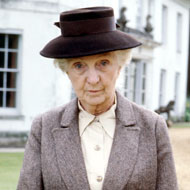
Some are less brilliant than others; some recycle the same plot under a different guise (as Dame Agatha herself slyly informs us in the person of Mrs Oliver, the most beautiful self-insert ever created); some are implausible; some frankly impossible; all of them are a delight to read. I started out a die-hard fan of Poirot, grew into a Tommy and Tuppence fangirl, and at this point in my life am firmly Team Marple. Murder at the Vicarage is one of my favorite stories of all time, and who can help but love the opening to The Body in the Library?

"But the worst is so often true."

(While on the topic of Mrs Oliver, her indignation at the assumption she bases all of her characters on real people, as well as her description of how she does come up with her characters (in, I believe, Hallowe'en Party), is so exactly along the lines of how I feel and the way I work that it never ceases to astonish and gratify me, every time I read it. And whenever I read now about authors who DO blatantly base characters off of real people, I wonder how on earth they can do so and still feel that the character belongs to them.)

Much of Maia, the MC of my 1920s adventure fantasy, is inspired by Virginia Revel of The Secret of Chimneys, as well as Bundle Brent, Anne Beddingfeld, Frankie Derwent, Tuppence herself, and others of Christie's "plucky girl sleuths." I think I love Virginia especially because she is older and has already HAD adventures, and yet is eager for more ("Oh Anthony! How perfectly screaming!" she says upon revelation of the hero's Dark Secret), and Anne for her impulsive yet essentially practical outlook on life (the way she cheeks Lord Nasby into giving her a job is priceless). "Let's have an adventure" is pretty much what my outlook on life has always been, and it's mostly thanks to Christie (well, CS Lewis shares some responsibility for that).

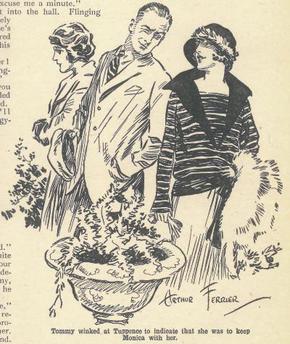
This image of Tommy and Tuppence is sheer delight

Agatha Christie truly is one of the greatest writers of all time, and while I've come a long way from that young girl delightfully shivering as she read about Poirot and Hastings tracking down an alphabetical maniac, I will never outgrow my pure enjoyment of her books. What better tribute can I give?

Monday, April 30, 2012

Influences: Terry Brooks

I've always liked the name Will. William seems stodgy to me, and Bill boring (or, as one William I know once put it, "a bill is a duck's mouth, NOT a person's name"), but I do like Will.

I put the responsibility for that squarely on the shoulders of two authors: Susan Cooper, for her fantastic Will Stanton; and Terry Brooks, for Wil Ohmsford of The Elfstones of Shannara.


I still vividly remember finding this book for the first time. It was at our old library, the one we'd been going to since before I was born. I had looked through the entire children's section and realized that I had read, if not all the books, almost all of them, and certainly all the ones that interested me (the Goosebumps books were completely safe from ever being borrowed by me). So, for the first time ever, I crossed the middle of the library into the adult section. I have no idea how old I was.

The above cover was the first thing I saw in the adult section. The very word "elfstones" caught my interest, followed very quickly by the Robin Hood-esque characters pictured. I added it to my pile, brought it home, started reading, and was instantly immersed.

The second Brooks book I read was The Druid of Shannara, which confused me horribly until I realized we were talking two separate Ohmsford generations, here. I didn't care so much about Walker, but I loved all the tidbits about Wren, and, not having Wikipedia at my fingertips back in those days, went back to the library and found all the Shannara books they had and began skimming them, trying to find the one that would tell me more about Wren. I finally found The Elf Queen of Shannara, and as you might have guessed, loved every word. I think I named a character "Wren" in every story I wrote for ages after that. She was awesome.


Over time, I've read all of the Shannara books except the short stories and graphic novels (and finally got them all in the right order), and most of the Landover series, too. I also read Sometimes the Magic Works, which is still probably my favorite book on writing, from a writer, ever (I also really love Madeleine L'Engle's A Circle of Quiet, but that's more of a book on life, from a writer, than just a book on writing).

As I've grown and broadened my fantasy horizons, I can see a lot more of the flaws in Brooks' writing than before. He certainly has no shame in utilizing tropes, or in using the same ideas and themes over and over (and over and over). His best books are, I think, his Word & Void books, which are gritty and dark, magic mixing with modern reality in a completely believable (and terrifying) way. The fantasy ones get repetitive after a bit, and I think the ones set in the more "modern" fantasy times (The Voyage of the Jerle Shannara books, and the High Druid books) are his weakest. My personal favorite is still Elfstones, both because it is the first I ever read, and for its characters - Wil, Amberle, Eretria, and Prince Ander.

Brooks is one of those rare writers who combines brilliant world-building with unique and dimensional characters (for the most part. Like I said, the later books get repetitive). And while someone today might dismiss him as following too many tropes, you have to remember that he is directly responsible for some of those things becoming tropes - other writers have copied off of him, turning his originality into tropes.

Sacrifice on a personal level for a greater, impersonal good is a continuing theme woven throughout his works. So is familial love, stronger than any spell. So is the seductive lies of evil contrasted with the harsh reality of good. So is the idea of one person, no matter how seemingly insignificant, refusing to give in to hatred and darkness, and turning the tide of the battle.

Cliches? Maybe. Truths that are important for people to be reminded of, even in fantasy version? Absolutely.

Not all evils can be fought with a sword (or elfstones). But evil can and must be fought every day, in all its various forms, by those who love peace, love goodness, love love itself. And I for one always appreciate the reminder of that I always get in Brooks' works, and try to incorporate some of those truths in all my own works, whether it be the obvious point of the story or simply the truth hidden behind my writing.

Heroes don't always look heroic, but the world needs them just the same.

Monday, March 19, 2012

Lessons From a Pig

picture from kristiyamaguchi.com

When I first heard that one of my long-time heroes, Kristi Yamaguchi, was writing a picture book, I was both excited and nervous. Excited because for one thing, there aren't enough books out there for kids that feature figure skating. Ballet, yes. Skating, no. Also excited because it was Kristi! I was nervous, though, because excellence in one area doesn't always translate to excellence in another. Not all figure skaters make great writers, and as a writer myself, I knew I would be hyper-critical.

I shouldn't have worried. Dream Big, Little Pig is a fantastic book! Instead of what I would arrogantly call typical inspirational tripe, gallant little Poppy taught an important lesson. You aren't going to magically be good at something and have everything handed to you on a silver platter just because you dreamed it - but if you love something, you should work hard and pursue it despite what other people say, and in that very pursuit there will be satisfaction. Awesome. My sister bought the book for my Joy when Joy just started skating, and I loved being able to read to her about how Poppy kept getting up every time she fell, and how eventually, she started falling less.

So when we heard that Kristi was writing a sequel titled It's a Big World, Little Pig, we were thrilled. And rightly so, because the sequel is just as charming as the first book. Aunt Lis and Uncle David bought this one for Joy to help celebrate her completion of her first season of skating lessons, and again, it is a fun story (with great illustrations) with an non-sterotypical message behind it. Poppy gets to go to a big international competition, and she's nervous, but soon discovers that all the competitors, despite being different animals from different countries, participating in different sports, they "all smile in the same language." I half-listened as Carl read it to Joy and Grace the first time, and I asked when he finished "But did Poppy win?" All three rolled their eyes at me. "It doesn't say," Carl said. "That is not the point."

Oh. Oops.


Not every athlete or actor can turn to writing stories, especially stories for kids, well, but Kristi certainly does. She inspires me to look at my own stories, and make sure I'm not falling into the trap of writing expected tropes, but instead pursue messages I would want my own girls to believe.
And to be perfectly honest, Poppy is a good inspiration to me, too - to not expect magical success, or to expect success to look like wild popularity or medals, but to work hard at what I love, just because I love it.

My big dreamer at her very first ice show (she's the one in front)


Disclaimer: I am not being compensated in any way for this review, and the opinions therein are solely my own. And my children's, so far as they have communicated them to me. :-)


Tuesday, January 24, 2012

Influences: Susan Cooper

Susan Cooper has been one of my favorite writers for oh, close to twenty years now, so I was delighted yesterday when looking over the list of ALA winners this year to see that she has been awarded the 2012 Edwards Award for The Dark Is Rising series. (Former winners include Gary Paulsen, Madeleine L'Engle, Lois Lowry, Orson Scott Card, and last year, Terry Pratchett.)

I don't remember exactly how old I was when one of my older friends recommended Cooper to me, but I know I was young enough that Dad read through the books first, just to make sure there wasn't going to be anything in them that would give me nightmares, and also so that he could talk with me about anything that might scare me in them (and why it was Dad who did that with these books, instead of Mom, I'm not exactly sure, because usually Mom was the one who did nightmare-screening for me - but it might have been when she was working, and didn't have as much time, or it might simply have been that Dad thought they looked interesting). Dad liked the first one so much he read the rest of the series for his own enjoyment, not because he was worried for me. I think it's the first series (but certainly not the last) that Dad and I both loved, instead of Mom and I. We also both loved the Arthurian connection - we're kinda both geeks when it comes to King Arthur!

The curious thing, for a nightmare-prone kid like me, is that even though they were eerie and intense, they weren't outright scary. I was certainly creeped out a few times during the reading of them (I think Greenwitch was the creepiest, for me), but not enough to trouble my dreams. I think because good, no matter how beleaguered or desperate, always triumphed in the end, even (and often especially) through the frailty and love of flawed human beings.

And Will. Short, stocky, serious Will, with the enormous loving family and the heavy burden he shouldered so ably. His friendships with Merriman, with Bran, with the Drew children, and within his own family all so different, and drawn so finely.

Merriman himself was my first introduction to a character who was both good and hard, who could be ruthless in his pursuit of the Light. The Light that burns, sometimes, that doesn't have room for softness - now, of course, that idea is commonplace, but at the time, I'd never read anything that showed that goodness doesn't always look good and can, in fact, sometimes look cruel, that looking at the big picture can sometimes mean the details get blurred.

Cooper is another of those writers whose books shaped not just my own writing, but my life. I really can't think of what sort of a writer I would be today were it not for the richness and depth of her stories. She has written many books besides The Dark is Rising series, of course (I bought Victory! for my dad for his birthday a few years ago - another one that we both loved), and I've enjoyed almost all of them, but tDiR has a special place in my heart.

Not to mention, of course, that I hold her and Lloyd Alexander between them directly responsible for my love affair with Wales, that land of magic and mystery and heroism. Which makes me think - maybe this is the year for me to pull out my Welsh language materials that I've had for an embarrassingly long time and get to work teaching myself the language. Maybe I should teach it to Joy and Grace at the same time, we three can learn together!

Or not.

Tuesday, September 13, 2011

Influences: Elizabeth Enright

Another one of the few non-fantasy authors who have been an enormous influence on my writing and my life, Elizabeth Enright doesn't get anywhere near the appreciation she deserves, in my opinion. Which sounds odd, considering she won a Newberry Medal for Thimble Summer. It's been my experience, however, that most people get a blank look on their faces when you mention Enright's name, and then only vague recognition comes with the mention of Thimble Summer.

I thoroughly enjoy Thimble Summer, but it can't hold a candle to my favorites of hers - the Gone-Away books. Whether it is the close relationship between a boy cousin and a girl cousin, reminding me so happily of the friendship between my cousin Zach and me, or the idea of a hidden, old-fashioned community, or (in the second book) all the fun of renovating an old house (which, having lived through, is Not Really Fun At All, but Enright made it seem fun), and moving to the country after having lived in the city ... whatever it was, the books were a delight. I especially like that, unlike so many YA and MG books, the adults are present and involved, while the children still have freedom to explore and be brave and get themselves in and out of trouble. We need to see more of that in books for young people!


Then there's the Melendy Quartet. I've written in my favorites posts about this family - Randy and Rush and the family overall. I love them. I want them to be my next-door neighbors. I want to have had Randy and Rush to adventure with as a kid, and I want them all to be my kids' friends. They are real, and delightful, and funny, and brave (and occasionally not), and ambitious, and loyal and loving.


I think what I like best about Enright's books, and her characters, is that perfect blend of realism and idealism. While the Melendy gang have marvelous adventures and impossible luck, they also feel like real people, people you could meet any day walking down the road. Same with Portia and Julian and the rest of the Gone-Away crew. As for Garnet of the wheat-colored braids, despite living in the hardest of times in American recollection, the Great Depression (a farmer's daughter, no less), there is no grimness in her; she still exudes the natural joy of childhood, mixed with a very real worry for her parents' livelihood.

Another factor that has always personally influenced my delight in Enright is the friendship that exists between boys and girls, without any romance or foolishness, just very easy and natural. Garnet and Jay and Rush and Randy are, true, brother and sister, and Portia and Julian cousins, so romance would be quite ick in their cases, but so many writers only seem to capture the squabbling side of boy-girl family relationships, or the exasperation each feels for the other. There is some of that in Enright's books, as there is in life, but there is also the deep and meaningful friendship that only comes when boys and girls are friends with each other, instead of boys only being friends with boys, and girls only being friends with girls. I love that Enright shows those sorts of friendships are possible, instead of assuming there must always be this unfathomable chasm between the two. Ugh! No wonder we have such problems with gender discrimination; it is so ubiquitous, even in children's literature!

Whenever I want to capture some of the sense of my childhood, I re-read an Enright book. And in my writing, I try to keep in mind how natural and fun her characters all are, regardless of the book's setting. When children who were created sixty, seventy, eighty years ago feel more real than children written about today, you know something has been done right!

Are you familiar with Elizabeth Enright? If so, which is your favorite book? What are some books you can think of that feature really excellent boy-girl friendships, without any hints of romance?

Thursday, September 1, 2011

Music

Thank you to those who commented on the last post! I was asking the question because I was stuck on figuring out a particular magical adventure in my MG fantasy, and I wanted to see what, if any, were some common threads that wove throughout most people's childhood dreams. There was one, too! It was ... flying, whether on winged horses, flying carpets, or just on one's own. Pretty neat, to see how much so many very different people have in common from childhood.

And now on to today's topic, which is, as the title suggests, music.

My sister and I were very fortunate, growing up. We had parents who refused to listen to, or allow us to listen to, bad music. So my childhood music memories include listening to Prokofiev's Peter and the Wolf; making up dances to Bach; humming John Denver along with Dad; and taking naps accompanied by songs about phonics ("Apple, apple, a,a,a") and Spanish-to-English translations of simple phrases, also set to music.

Awesome stuff.

Thanks to such a diverse and rich background musically (I don't really remember listening to much kid's music at all, except for Raffi, naturally, and Peter, Paul, and Mary, and the aforementioned tape with the learning songs on it - which I now have in CD form for my littles), I find that I still appreciate a wide variety of music. Different sorts for different moods or needs! I like:

Beethoven or Hayden for cleaning

Mozart-Handel-Brahms-etc. for relaxing

Bach for inspiration

And for just general listening, or if I need a specific kind of music for a specific kind of story: Owl City; Regina Spektor; Marina and the Diamonds (some); Lenka; Ingrid Michaelson; Kate Nash or Lily Allen (some); and, of course, Michael Buble.

And then there's the Celtic music I like, whether instrumental or with vocals. And thanks to growing up with a string-pickin' father, I'm a sucker for American folk music.

I'm trying to imitate that same sort of diverse background for my littles; we do have a bunch of children's music, but it is all either Raffi (EVERY kid needs to grow up listening to Baby Beluga, which my Joy freely adapts into "Heaven above and the sea below, and a little white hi-ip-po - whee, whee, whee!"), or more folk music, adapted for kids. We are big fans of Elizabeth Mitchell and Lisa Loeb! More often, they listen to whatever Carl and I are listening to - which can be anything from instrumental hymns to Brahms to Michael Buble!

Do you have music that you listen to for specific tasks? When you write, do you have music playing in the background, or do you need silence, or does it depend on the story (it does for me - some stories I need to write in silence, while some require music to put me in the proper mindset)? What sort of music did you listen to as a kid, and do you still find yourself drawn to that sort of music now?


Disclaimer: I am not associated or affiliated with any of the artists mentioned in this post; the opinions therein are my own.

Tuesday, June 14, 2011

Influences: Diana Wynne Jones

Even though I only discovered her a few years ago, DWJ has ended up being an enormous influence on my writing, especially right now.

Every time I would pass her books in the store or library, I'd see the edition of one of the Chrestomanci books that has a cat on the cover, and I would think, "Ugh, feline fantasy. BORING."

(Note to publishers - if a book is not, in fact, about cats doing magic, you might not want to imply that on the cover.)

Then, in recent years, more and more of my friends started recommending her books. I was getting desperate for good YA Fantasy, since Lloyd Alexander was gone and my list of favorite authors was growing smaller and smaller. Finally, I picked up the very volume with the cat on the cover, and gave it a try.

You can imagine my indignation when I discovered this wonderfully witty, clever, pithy writer, with a delightful story that had pretty much nothing to do with cats! I felt so cheated. I could have been reading her for years, and I'd missed out just because of a dumb cover. Her twisty way of turning plots around kept me tearing through the stories, and then going back and re-reading them so I could pick up the little nuances I missed the first time around.

Even better, for me, than the Chrestomanci books was Howl's Moving Castle (I think it's that way for a lot of people, yes, no?), with the delightful Sophie who only figures out who she truly is when she's transformed into an old woman and no longer cares about society's conventions and her family's expectations.

I had already starting writing The Eldest Sister before I read DWJ, but I admit to being a little concerned about some of the superficial similarities between it and HMC. I didn't let it worry me too much, though, since TES was such a different story and different tone.

Then I re-read HMC just a few weeks ago, and realized that I would much, much rather read that than TES. The similarities were just enough to show me how far off I had gotten with my own story. And that was what prompted me to ultimately pick it up and start from scratch again, changing a few of the basics so that it wouldn't seem to be copying too much from DWJ, and determining to make it me, my voice, E Louise Bates as distinctly as all Diana Wynne Jones' books are hers. 

I freely admit that I am nowhere near as witty or talented as she is, but that's okay. I have my own voice, and thanks to DWJ, I am remembering how to use it.

Wednesday, May 4, 2011

Influences: LM Montgomery

I don't remember a time in my life when I wasn't acquainted with Anne Shirley. I can't quite remember now which came first, watching the movie or reading the book, but they certainly happened close together. Thankfully, the movie never ruined the book for me, and while these days I have to grit my teeth through parts of the sequel (and I refuse, utterly and completely, to ever watch the third), even knowing and loving the books as well as I do, I can still watch the movie without flinching.

This fellow might have something to do with that. Oh, Gilbert!

I've never been as big a fan of the Emily books - I adore Emily of New Moon, but the later two books of the trilogy get under my skin in parts. Frankly, Emily herself infuriates me the older she gets, as does Ilse.

However, as one who grew up in an extended family that can only properly be called a clan, with aunts and uncles and cousins galore, as well as second cousins and the like (my father is the oldest of eight; his father was also the oldest of eight, and his mother was one of five), my favorites out of all of LMM's works would have to be the Story Girl books. And not just because my sister and I watched Road to Avonlea every week on CBC when we were growing up! The books are so different from the show.

For one thing, the books didn't have him. Oh, Gus!

Ahem.

I love LMM's writing style. I even love her "purple prose." I've been writing LMM fanfiction since 2005. I started it as a bored and lonely newlywed, while Carl was at work and I needed something to distract me from my loud and inconsiderate neighbors, and the fact that I had no car or any way to get away during the day. Escaping to PEI, and a simpler time, more romantic way of life, an era I've always loved ... well, it just might have saved my sanity. It certainly brought me some wonderful friends (hi, Adrienne and Cathy!) who shared my love for LMM and her works. 

Thanks to LMM, I learned how to explore different genres of writing besides just YA fantasy. I learned to play with different styles, to change my tone depending on what type of story I was writing. I learned that, as Mr Carpenter tells Emily, "pine woods are just as real as pigsties, and a darn sight more pleasant" - meaning, don't let other people force you to write ugly things just because they are "realistic." I learned how to write gentle romance (romance of any kind always having terrified me before).

I also developed a mad, passionate love affair with adjectives and rambling descriptions, which I am now desperately trying to combat. Not all influences are good!

I recently started my eleventh LMM fanfic (yes, for those of you who follow my LMM stories, that would be Gwen's WWII story). I am not exactly working hard on it, having a few original projects that are taking most of my attention, but it is growing in my brain and a little bit on paper. No matter if I ever get published, or wherever my writing takes me, I suspect I will always have some LMM story brewing on the side.

It's the least I can do to honor the woman who brought such magic to my childhood (and adulthood, if I'm honest).

Did you grow up reading the Anne books? Did you have a crush on Gilbert Blythe (or Gus Pike)? Is there a book that you have read for so long that you can't remember a time when it wasn't part of your life? Do you write or read fanfiction at all?


Saturday, April 9, 2011

Two Giants

I've been re-reading the Redwall series ever since Brian Jacques' death. Thankfully, I own all of them but the most recent, so the biggest challenge in reading them has come from trying to remember the original published order instead of the chronological order I had them in on my shelves. Thank goodness for internet resources!

With the passing of Diana Wynne Jones, I've decided to intersperse the Redwall books (and the Flying Dutchman books, which I also own) with some of hers. I was going to start re-reading the Chrestomanci books, but I don't own any of those, and somebody else at our library must have had the same idea, for the first two were checked out today when I looked. As was Howl's Moving Castle, which was my second choice.

So I'm reading Enchanted Glass right now, and I have the collection of short stories Unexpected Magic to read as well. It'll do until I can get my hands on the Chrestomanci books.

I came to Jones late - not until last year or the year before as a matter of fact. I'm not sure how I missed her as a kid - with my affection for Lloyd Alexander, E Nesbit, and others of like ilk, she would have been right up my alley.

Be that as it may, I have thoroughly enjoyed her books ever since I discovered them. Sometimes I have a hard time wrapping my head around what's happening, and often the endings leave me feeling vaguely confused (or, in the case of Fire and Hemlock, completely and totally confused, and having to re-read the ending several times over to make any sense of it). But I like that. It's not the same frustration I feel when I read Robin McKinley, and the first half is thrilling, I get bogged down in the second, and by the end I am so in the dark I barely remember the story I'm reading at all (though oddly enough I keep going back to McKinley, so there must be something compelling about that sort of writing, too).

I like having to think while I read. I like the sense of satisfaction when I've figured out the hidden twist (I was so very tickled when reading The Game because I got it before All Was Revealed); and I like, sometimes, knowing that the writer completely pulled the wool over my eyes.

The Redwall books are my comfort books. Not only have I read them a million times, they all follow the same pattern. I know exactly what is going to happen in each one, and reading them gives me a comforting sense that everything is right with the world, and whatever isn't will work out eventually.

I'm so very, very sad that these two marvelous writers had to die at all, especially so close to each other, but I think that reading their books intertwined with each other is actually going to be very good, and very helpful for me as a writer, because it will be me a much clearer sense of their very different styles, and what each style accomplishes, and what I need to do in order to achieve a certain atmosphere for my books.

And hopefully in studying their styles I will start to break myself of my habit of over-using adjectives - something I didn't even realize I did until I was working on the last few chapters of my LMM fanfic the other day, and discovered that I peppered it with adjectives all over the place. Not too bad for LMM fic, since she was also adjective-happy, but not a habit I want to indulge in for my own writings!

Are you familiar with Jacques and Wynne Jones? What do their books do for you? What are your "comfort" books, and what are your "mind-stretching" books? Which do you prefer in the Redwall series, hares or otters? And finally, what are some of your bad writing habits that you have a hard time shaking?

Saturday, February 19, 2011

Influences: Edward Eager & E Nesbit

I put these two writers together because of how inextricably their writing styles are connected in my mind. That, and because I only discovered E Nesbit through Edward Eager's books.

I'm not sure how old I was when Mom helped me find this great-looking book in our local library - green and white hardcover, with a front figure who was half girl, half knight (and a very smug cat in the background). It looked terrific, so we brought it home to read.

That book was Half Magic, by Edward Eager, and not just me, but my mother and sister fell in love with the four siblings, who squabbled and worked together and had fun and were thoroughly human. The magic was perfect, too - not only was it not magic that just came easily to them, they didn't even understand its rules. As Eager himself put it, first it thwarted them, then they had to learn how to thwart it, and in the end, when they had finally learned how to work it well, they gave it up for something better.

When we went back to the library the next week, we promptly checked out all the rest of Eager's books, and loved almost all of them just as much. I've never been quite as fond of Magic or Not? or The Well-Wishers, but even those I've grown to appreciate more as I've gotten older. Knight's Castle led me to read Ivanhoe at age twelve (no easy task, but well worth the effort), and I remember building Lego castles to imitate Torquilstone for months after.

In each of his books, Eager's children reference reading E Nesbit's books. This, naturally, led me to search for some of her works, as well. Mom was familiar with the Bastable books, but not the others. I think the first one I read (also borrowed from the local library) was Wet Magic, a solid red hardcover with no dustjacket, looking alluringly thick and mysterious. From there I discovered The Phoenix and the Carpet, and all the rest of her wonderful works.

Confession: I actually prefer Eager to Nesbit. I know she was a pioneer, and I admire her tremendously, but sometimes I feel there's almost too much of a hard edge to her stories. Eager's are a bit more light-hearted, and I enjoy that - though that's a matter of personal taste, and I can certainly see why someone else might prefer Nesbit for that very reason.

My favorite Nesbit book, as it was for the children of Half Magic, is The Enchanted Castle, and when my parents got me the hardcover with Paul O Zelinsky's stunning illustrations for a birthday present one year, I was thrilled (I think it might have been one of the first hardcovers I ever owned - if not the first, then one of the very earliest). I still have that book, displayed prominently on my shelves.

Through Eager and Nesbit, I learned the fun in reading - and writing - real people, as opposed to caricatures. I learned that reading about children arguing and teasing each other, and making up, and being loyal to each other through it all, just like my sister and my cousins and me, was delightful. I learned that one didn't have to fall through a rabbit hole, walk through a wardrobe, or travel by tornado to find magic - it just might be lurking around the next corner. One should always keep ones eyes open, because one never knew when magic might happen.

And really, what better way to live than in that kind of delightful anticipation? I might never have found actual magic (by the way, what a great title for a book - Actual Magic), but I certainly found the world a very magical place all on its own, just by keeping my eyes open to its possibilities.

I've always found it very sad that there was no successor to Eager, as he was successor to Nesbit. Others have imitated, but nobody else has come close to matching their style, their wit, and their fun.

I've always had a sneaking hope that maybe, someday, I might be able to take up that mantle. After all, if I benefited so much from reading them, oughtn't I help point the way back to them for future generations of readers, as well?


Are you familiar with Edward Eager and/or E Nesbit? If so, which author did you find first, and which do you prefer? Do you remember what books that meant a great deal to you as a child looked like? What were some of your earliest favorites, and how did they shape your perception of the world?

Sunday, February 13, 2011

Influences: L Frank Baum

One of the stories my parents like to tell about me is how I read The Wonderful Wizard of Oz all the way through, all by myself, when I was in kindergarten. That may not seem so impressive now, but back then, most kids went into kindergarten not even knowing how to read. So I was definitely an anomaly.

It can be hard, when you have a kid who reads so fluently so early, to find books that hold their interest writing-style, and yet don't tackle subjects that are beyond their comprehension. Baum's books were perfect in this regard - the writing was sophisticated, yet the stories were simple enough that even an over-sensitive six-year-old like myself could read them without being scared or confused, or even simply overwhelmed with concepts beyond my ability to understand.

Baum has been criticized considerably for "sugar-coating" Oz too much, turning it into a place where nothing truly bad could ever happen, and while I understand that criticism, there was (and still is, really) always something very comforting about taking a trip to Oz.

(Never mind the fact that as it was HIS creation to begin with, he could do anything he wanted with it, and people still wouldn't have had the right to complain. After all, if you don't like it, don't read it, but don't act as though the author is somehow presenting a false impression of a real place when it was all from his head to begin with. Ahem. Small rant over.)

One of the other great things about Oz was that there was enough humor for small people, but the puns and plays on words are sheer adult amusement. I rarely, even to this day, get through an Oz book without a surprised and delighted snort at something that went completely over my head as a kid.

I have heard the theory that Oz was meant to be a metaphor on communism or capitalism or something political. Maybe it was. But I know that it can be read without any kind of political background, and enjoyed as sheer good story-telling, and that is how I prefer it. I would much rather not see a possible political background to a good story than misread a grand yarn as a thinly-disguised treatise on capitalism.

So, how had Baum inspired me? Well, aside from being, as I mentioned at the beginning of this post, one of the very earliest writers I ever read alone, and quite possibly responsible for my lifelong love for fantasy, from Baum I learned the sheer joy of world-building, of creating a place that exists quite independently from the characters, and has its own history and inhabitants and can quite happily sustain any number of stories, just as this world can.

From Baum, too, I have learned the fun of playing with words, of subtle humor, of inside jokes between the writer and reader, at the characters' expense. I tend to be more of an invisible narrator, telling my stories solely through the eyes of my characters, but I always enjoy taking a break from that role once in a while and trying that omniscient narrator bit that Baum does so well.

And, of course, Baum was a master at creating realistic children, spunky heroines and heroes who frequently found themselves in scrapes, but by using ingenuity and courage always worked their way out. Dorothy is beloved by so many, I believe, not just for her staunch loyalty to Uncle Henry and Auntie Em, but for her wit and spirit, and for the fact that even after she came to Oz permanently and became closest companion to the ruler of Oz, she still maintained her independence and practical outlook on life. In some ways, she was wasted in such a happy land as Oz. She would have made a wonderful explorer and adventurer in this world, as well as a great righter of wrongs. Alas! She is safe in Fairyland, and it is up to we other writers to create our own characters to right those wrongs, and have those adventures.

Perhaps, if we are very fortunate, one or two of them might in time be as well-loved as brave little Dorothy Gale.


Are you a frequenter of the land of Oz? Do you enjoy it, or do you find Baum's stories too safe for your taste? Who is your favorite "spunky girl heroine" in children's and/or YA literature? And what was the first chapter book you can remember (or others remember about you) reading on your own?

Sunday, February 6, 2011

Influences: Lloyd Alexander

I've been thinking about doing a series of posts on authors/books/series that have influenced my writing the most over the years ... those are the sorts of series I always enjoy reading from other people, seeing what has gone into forming their writing style. And sometimes it helps me discover authors or books I otherwise might never have known!

So, to begin: I considered doing, for this first post, something on the first writer who influenced me, but instead I decided to look at the writer who has been the biggest influence on me, my writing and my life. That writer is ...

Lloyd Alexander.

I can't remember, exactly, which of Alexander's books I read first. It was either a Vesper Holly or The Wizard in the Tree. Whichever it was, I was immediately hooked. I read voraciously through all of his works in our local library. The Westmark trilogy, though I know many people don't care for it, was the one that affected me the most, however. The very fact that there was no magic in it, that though a fantasy it was very real, and very grim, brought it much closer. Theo's struggles with morality, especially in Kestrel; Mickle's journey to finding herself and her place; Sparrow and Weasel and Keller ... I don't think I'd ever read something that touched me quite so deeply. (Oddly enough, I found myself mostly unaffected by Florian and his children.)

Alexander is best known for his Prydain Chronicles. I only started reading those after I'd already read most of his other books. Not by design - simply because our library didn't have all of them, and I hate only reading partial series. It wasn't until I started visiting a different library, which had the entire series, that I read them and fell in love with the Assistant Pig-Keeper and opinionated Princess Eilonwy.

For my own writing, Alexander's use of humor, and his ability to tell a full and rich story with only a few well-chosen details, have been what I have studied the most closely, and tried to incorporate into my own works.

As a human being, the ideas he portrays about heroism, sacrifice, love, and life have been what I have tried to incorporate into my daily living. The very best writer does not just present a good story, but through his story inspires you to be a better person, and that is what Alexander has always done for me.

His final book, finished right before his death in 2007, is The Golden Dream of Carlo Chuchio. I usually prefer to buy books in paperback, but I pre-ordered that one, in hardcover, to come as soon as it was published. As with all his others, it blended humor and truth in perfect proportions, and never came close to preaching. It was a fitting epitaph to his life.

Every time I go into a bookstore these days, I find myself drifting hopefully over to the "A" section of both children's and YA, wistfully thinking that perhaps they will have discovered some previously unpublished works among Alexander's papers, and be able to offer us just one more story from him. Alas, I think we are destined to only be able to re-read the books already published, but at least they are well worth the journey. There are very few writers of whom I can say this, but every time I read one of his books I find something new in it.

From all I understand, Alexander exhibited those traits in his life he showed so well through his writing - humility, humor, kindness, practicality, and a keen zest for the adventure of life.

He has been a tremendous influence on me, both as a writer and human being, and I can only hope that someday I might be able to carry on his legacy in my own writings.

Are you familiar with Lloyd Alexander? If so, which is your favorite book, and why? (I think The Arkadians just barely tops my list, but I love them all too much to choose just one favorite!) What was the first book you read of his, and what do you remember most about it?